 Inside WTM Africa 2026, its biggest ...
 8 000+ attendees, 780 exhibitors, and record growth
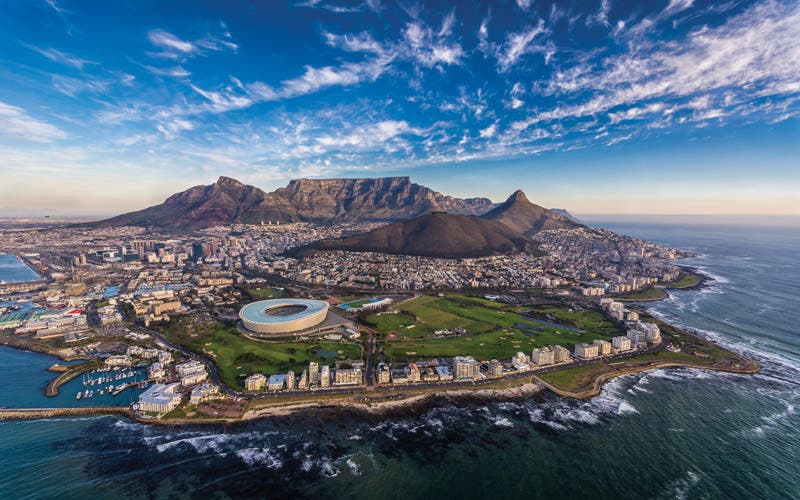
With Green Point being a possible world cup 2010 location, the area is being researched on for instance historical importance.
Greenpoint used to be a sandy wilderness where now extinct Cape lions roamed; the final resting place of unknown slaves and unmourned criminals, a playground for British army officers, a place of temporary exile for defeated Boer prisoners-of-war...
Now, much of its varied history has been summarised in a report by archaeologists Mary Patrick and Harriet Clift of Cape Archaeology Survey, part of the overall environmental impact assessment of a proposed 68 000-seater 2010 World Cup Stadium that, if approved, will once again change the face of this part of the city.
The archaeologists' research shows that, in the pre-colonial era, the coastal plains of the greater Peninsula area were used as seasonal grazing by the original pastoralist inhabitants of the Cape, the Khoekhoen (the now-accepted spelling for the Khoikhoi).
In 1995, the remains of four people interred in two cairn graves were discovered during excavations in Cobern Street (off Somerset Road, near Gallows Hill). They were buried in a style consistent with Later Stone Age coastal burials and associated with the Khoekhoen lifestyle, and because they were not all buried at the same time - the graves appear to have been re-used - their presence suggests there may have been other prehistoric burials in the sand dunes along the Atlantic coastline.
"Although the landscape of the Green Point Common has been extensively reshaped, there is still a possibility that some Stone Age shell middens as well as human skeletal remains may be found," the authors say.
During the 17th and 18th centuries the coastal plain to the west of Cape Town was referred to as "de Waterplaats", or the waterfront, and by the beginning of the 19th century as "de vlakte genaamdt de Groene Punt" - "the plain named Green Point".
The area was used for grazing cattle and historical maps and records describe the Khoekhoen using it as a camping site well into the 18th century. In the early part of this century it was still a wilderness, covered in dense shrubs and frequented by Cape lions.
As early as 1710, it was practice to bury both corpses from the Dutch East India Company hospital and dead slaves in the sand dunes outside town. An early 18th century map shows a gallows and two small crosses at the foot of the dune closest to the town. This area became known as Gallows Hill - the current site of the traffic department - which was then a chalky rise about 20 feet high.
Public executions occurred here from the early 18th century, with the remains of the executed being left on public display and their bones eventually being buried on the eastern slopes of the hill.
According to custom, members of the Dutch Reformed Church were buried within the walled cemeteries, while unbaptised slaves and heathens were buried in the unwalled area further west. But the expansion of the town into this area in the early 19th century - the first 28 erven along the Signal Hill side of the Common were alienated in 1813 - caused some problems.
The first (old) Somerset Hospital was built in 1818, next to the walled cemeteries. It was replaced in the mid-19th century by the new Somerset Hospital, on the eastern edge of the Common between Fort Wynyard and the Breakwater Prison. There was also a paupers' burial ground, known as "White Sands".
The authors say it is "unlikely" that the two proposed sites being investigated for the possible stadium construction would contain mass burials relating to either the informal burial grounds along Somerset Road and the Gallows Hill paupers' burial grounds dating from the 18th and early 19th centuries. "However, the presence of ad hoc burials of sailors in this area cannot be excluded."
The Common was also used during the Anglo-Boer War from 1899 to 1902. "Although it is unlikely that much remains of this occupation as far as archaeological remains are concerned, the site is significant in terms of historical association," say the authors.
"The social history of the proposed (stadium) development falls outside the scope of this project, but needs to be addressed as part of the wider Heritage Impact Assessment in relation to the Metropolitan golf course and the existing Green Point stadium," Patrick and Clift conclude.
---
There are only 20 seats available at the Disappearing Dining Club.
Expect big things (and a big party) at the 10th anniversary of the Cape Town Festival of Beer.
Help break the stigma surrounding mental health, self-harm and suicide at this sunrise 5K, Darkness Into Light.
Source: greenpointcommon.co.za / May 12, 2006
Subscribe to our free newsletter and learn more about Cape Town's history
 Wescape City close to Cape Town
 A new R140-billion development for the Western Cape. Will you be living in this ...
 Leadership, scuba diving, concerts + ...
 Plus markets, fun runs and youth-led conversations (June 16)
 (Y)our Secret Season: Have a better ...
 Specials & special things to do this winter. Plus daily wins





© 2005 - 2026 Cape Town Magazine PTY Ltd. All rights strictly reserved [2005 - 2026].